Medical records can contain thousands of pages of information, including physician notes, hospital records, diagnostic reports, medication histories, imaging results, laboratory findings, and treatment documentation. For attorneys handling personal injury, medical malpractice, wrongful death, workers’ compensation, or other healthcare-related cases, understanding these records is an essential part of case preparation.
However, reviewing extensive medical documentation can be time-consuming and challenging. Important details may be buried within lengthy records, dates may be inconsistent, and critical events may be spread across multiple healthcare providers and facilities.
Medical record review for attorneys helps transform complex medical documentation into organized, understandable, and useful information for legal case analysis. A structured review can help attorneys understand a patient’s medical history, identify important events, recognize documentation gaps, and prepare more effectively for case evaluation, discovery, expert consultation, and litigation.
In this guide, we will explain what medical record review is, why attorneys use it, what the review process involves, and how it can support legal case preparation.

What Is Medical Record Review for Attorneys?
Medical record review for attorneys is the systematic examination, organization, and analysis of a patient’s medical documentation for legal case purposes.
The process involves reviewing records from hospitals, physicians, specialists, diagnostic centers, rehabilitation facilities, and other healthcare providers to understand the patient’s medical history and the sequence of events related to a legal matter.
A medical record reviewer may examine:
Patient history and initial complaints
Physician and nursing notes
Emergency department documentation
Diagnostic tests and imaging reports
Medication records
Surgical and procedure reports
Treatment plans and follow-up care
Discharge summaries
Referral records
Laboratory results
Documentation of complications
Relevant changes in the patient’s condition
The objective is not simply to summarize the records. A structured review helps organize the available information so attorneys can locate relevant facts, understand the treatment timeline, and identify areas that may require further investigation or expert review.
Medical record review services may also help create medical chronologies, identify missing records, organize relevant documents, and prepare case-specific summaries.
Why Medical Record Review Is Important for Attorneys
Medical documentation often plays a central role in litigation involving injury, healthcare treatment, disability, causation, damages, or alleged medical negligence.
Without an organized review, attorneys may spend significant time searching for important information across hundreds or thousands of pages of records.
A professional medical record review can help attorneys in several important ways.
1. Understand the Patient’s Medical History
A patient’s medical history may extend years before the incident involved in the case.
Understanding previous diagnoses, injuries, treatments, medications, and medical conditions may help attorneys evaluate the available evidence and distinguish pre-existing conditions from later developments.
This is especially important in personal injury cases where the opposing party may raise questions about prior injuries or health conditions.
2. Identify Important Events and Treatment Dates
Medical records frequently contain multiple dates associated with appointments, procedures, diagnoses, and follow-up treatment.
Organizing these events chronologically helps attorneys understand what happened, when it happened, and how the patient’s condition changed over time.
3. Locate Relevant Medical Documentation
A structured review can make it easier to identify records related to a specific injury, diagnosis, procedure, complication, or treatment decision.
Instead of searching through an entire medical file repeatedly, attorneys can use an organized chronology or summary to locate relevant information more efficiently.
4. Identify Potential Documentation Gaps
A review may reveal missing documents, incomplete treatment information, unexplained gaps in follow-up care, inconsistent dates, or references to records that were not included in the provided file.
These observations can help attorneys determine whether additional records should be requested.
5. Support Case Evaluation and Preparation
Organized medical information can help legal teams evaluate case facts, prepare questions, identify areas for expert review, and understand the medical documentation before depositions, negotiations, or trial preparation.
A medical record review does not determine legal liability. It provides an organized foundation for attorneys to evaluate the evidence and make informed decisions.
What Medical Records Should Attorneys Review?
The scope of medical record review depends on the type of case, the patient’s treatment history, and the issues being investigated.

Hospital Records
Hospital documentation may contain valuable information regarding emergency treatment, admission, diagnosis, procedures, patient condition, and discharge.
Common hospital records include:
Admission records
Emergency department records
History and physical examination
Physician progress notes
Nursing notes
Consultation reports
Operative reports
Discharge summaries
Hospital medication records
Physician and Specialist Records
Records from treating physicians and specialists help document the patient’s ongoing treatment and medical condition.
These may include:
Office visit notes
Specialist consultations
Diagnosis and treatment plans
Follow-up recommendations
Referral documentation
Clinical examination findings
Progress notes
Diagnostic Records
Diagnostic documentation can provide additional context regarding a patient’s condition.
Examples include:
X-ray reports
MRI reports
CT scans
Ultrasound reports
Laboratory results
Pathology reports
Diagnostic testing results
Medication Records
Medication documentation may help establish the treatments prescribed, medication changes, dosage information, and documented responses to treatment.
Rehabilitation and Follow-Up Records
Physical therapy, occupational therapy, rehabilitation, and follow-up care records can help document recovery progress, functional limitations, ongoing symptoms, and treatment outcomes.
The reviewer should organize these materials according to the needs of the case rather than simply collecting documents without a clear structure.
The Medical Record Review Process for Attorneys
A consistent review process helps ensure that medical documentation is organized, understandable, and useful.
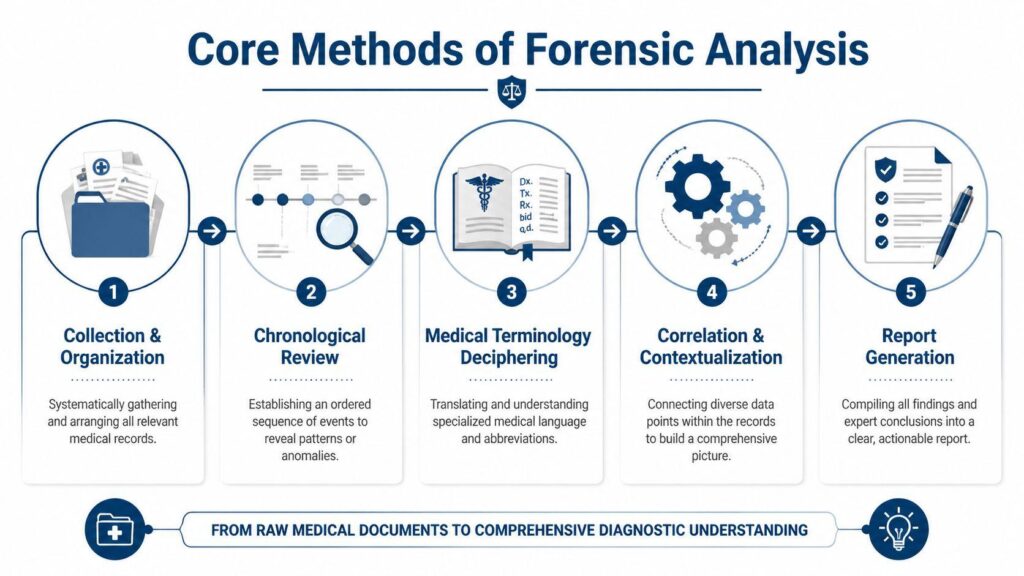
Step 1: Collect and Organize Medical Records
The first step is gathering the available medical documentation and organizing it according to provider, facility, date, and record type.
Records may arrive as PDFs, scanned documents, electronic health record exports, or mixed files containing different formats.
The reviewer should identify the available documents and organize them in a logical sequence.
Step 2: Review the Medical Documentation
The records are examined to understand the patient’s medical history, diagnoses, treatment, symptoms, procedures, and relevant clinical events.
This step involves reviewing the documentation carefully rather than relying only on isolated summaries.
Step 3: Build a Medical Chronology
A medical chronology organizes significant events in chronological order.
It typically includes:
| Date | Provider/Facility | Event | Relevant Findings |
|---|---|---|---|
| Jan. 10 | Emergency Department | Initial evaluation | Patient reported symptoms |
| Jan. 11 | Hospital | Diagnostic testing | Imaging performed |
| Jan. 12 | Treating physician | Treatment plan | Medication prescribed |
| Jan. 20 | Follow-up clinic | Progress evaluation | Symptoms reassessed |
These are illustrative examples only—not actual patient records.
A chronology allows attorneys to understand the sequence of events without having to repeatedly navigate the full medical file.
Step 4: Identify Key Issues and Documentation Gaps
During the review, relevant observations may include:
Differences between documented symptoms and later reports
Missing records referenced in other documents
Unclear treatment dates
Changes in diagnosis
Documented complications
Follow-up recommendations
Relevant test results
Important treatment decisions
Potential inconsistencies within the documentation
These findings should be presented objectively and tied to the available records.
Step 5: Prepare an Attorney-Focused Report
The final report should present the findings in a clear, organized, and practical format.
Depending on the scope, it may include:
Executive summary
Medical chronology
Key medical events
Relevant diagnoses
Treatment overview
Important record references
Potential documentation gaps
Supporting page references
Areas requiring additional review
The goal is to make complex medical documentation easier for the legal team to navigate.
What Is a Medical Chronology and Why Do Attorneys Need It?
A medical chronology is a date-based summary of significant events documented within a patient’s medical records.
It is one of the most useful tools produced during medical record review because it organizes the patient’s treatment history into a chronological sequence.
Instead of reading hundreds of pages to determine when a particular event occurred, attorneys can refer to the chronology to locate relevant information quickly.
A medical chronology may include:
Date of treatment
Healthcare provider or facility
Symptoms reported
Clinical findings
Diagnosis
Treatment provided
Medication information
Diagnostic testing
Follow-up instructions
Relevant page references
Benefits of a Medical Chronology
Improved organization: Medical events are arranged in a logical sequence.
Faster information retrieval: Attorneys can locate key events without searching through the entire file.
Better case understanding: The chronology provides a clearer overview of treatment progression.
Easier preparation: Attorneys can use the timeline when preparing questions, reviewing evidence, and consulting experts.
Record navigation: Page references can help the legal team locate supporting documentation.
A well-prepared medical chronology is not merely a list of dates. It is a structured reference tool that helps the legal team understand the medical documentation in context.
Medical Record Review in Personal Injury Cases
Personal injury litigation often requires reviewing medical documentation to understand the injuries, treatment, recovery, and impact on the claimant.
Medical records may help attorneys evaluate:
The nature of the reported injury
Initial medical treatment
Subsequent diagnoses
Changes in symptoms
Treatment recommendations
Recovery progress
Medical expenses
Functional limitations documented by providers
Whether additional treatment was recommended
For example, a claimant involved in a motor vehicle accident may have records from an emergency department, primary care physician, orthopedic specialist, imaging center, and physical therapy provider.
Without organization, these records may be difficult to review as a complete treatment history.
Medical record review can bring these documents together into a structured chronology that helps attorneys evaluate the medical evidence and identify questions requiring further investigation.
Medical Record Review in Medical Malpractice Cases
Medical malpractice cases often involve extensive medical documentation and complex treatment histories.
Attorneys may need to understand the sequence of treatment, documented clinical findings, diagnostic testing, patient complaints, treatment decisions, and subsequent outcomes.
A structured medical record review may help identify areas that deserve closer attention, including:
Changes in a patient’s condition
Documented symptoms
Diagnostic findings
Treatment decisions
Follow-up recommendations
Recorded complications
Relevant gaps in documentation
Differences between records from multiple providers
However, identifying a potential issue within medical records is not the same as establishing malpractice.
Determining whether the applicable standard of care was breached, whether a breach caused harm, and whether the legal elements of a malpractice claim are satisfied generally requires appropriate medical expert analysis and legal evaluation.
A medical record reviewer can organize and identify relevant documentation, while qualified experts and attorneys assess the medical and legal implications.
How Medical Record Review Helps Attorneys Save Time
Attorneys and legal staff frequently handle multiple cases, deadlines, discovery requests, client communications, and case preparation responsibilities.
Reviewing large medical files manually can consume considerable time.
A structured medical record review can reduce the time spent searching for important information by creating organized reference materials.
Time-Saving Benefits
Reduces repeated searches through large medical files
Organizes records from multiple providers
Makes important dates easier to identify
Provides a quick overview of treatment history
Helps attorneys focus on case-specific questions
Simplifies preparation for expert consultation
Improves document navigation through page references
The time savings depend on the size, quality, complexity, and organization of the records, as well as the scope of the review.
Medical Record Review vs. Medical Chronology
These services are related but are not exactly the same.
| Medical Record Review | Medical Chronology |
|---|---|
| Examines medical documentation | Organizes key events by date |
| Identifies relevant medical information | Presents events in chronological order |
| May identify inconsistencies and documentation gaps | Helps locate when events occurred |
| Can produce summaries and findings | Primarily provides a timeline reference |
| Broader analytical process | Specific organizational deliverable |
A medical chronology may be one component of a comprehensive medical record review.
Attorneys may request both services when they need a detailed examination of medical records along with an organized timeline of significant events.
What Should Attorneys Look for in a Medical Record Review Service?
Selecting an appropriate medical record review provider is important because the quality and usefulness of the review can affect how efficiently a legal team works with medical documentation.
Attorneys should consider the following factors.
1. Accuracy and Attention to Detail
The reviewer should carefully examine the records and accurately reflect the information contained in the documentation.
Dates, diagnoses, medications, treatment events, and findings should be clearly presented without introducing unsupported conclusions.
2. Organized Reporting
The final deliverables should be structured in a format that is easy to navigate.
A clear report, chronological timeline, headings, and relevant page references can improve usability.
3. Case-Specific Review
The review should focus on the specific issues and objectives of the case rather than producing a generic summary of every document.
4. Relevant Medical Understanding
Medical terminology, treatment processes, diagnostic documentation, and healthcare records require careful interpretation.
Attorneys should understand the qualifications and scope of the reviewer’s work and whether medical expert analysis is also required.
5. Confidentiality and Secure Handling
Medical records contain sensitive personal information.
Attorneys should evaluate how a provider receives, stores, accesses, processes, and returns medical documentation, including the provider’s confidentiality practices and applicable privacy obligations.
6. Transparent Scope and Deliverables
Before beginning a review, the legal team should understand:
What documents will be reviewed
What deliverables will be provided
Whether a chronology is included
Whether page references are included
What the report covers
What falls outside the scope of the review
Clear expectations help avoid confusion during case preparation.
Common Challenges Attorneys Face When Reviewing Medical Records
Even experienced attorneys may encounter challenges when working with extensive healthcare documentation.
Large Volumes of Records
A single case may involve records from multiple facilities spanning years.
Sorting, reviewing, and understanding the documentation can require significant effort.
Medical Terminology
Clinical abbreviations, specialized terminology, diagnostic language, and treatment details may make records difficult to interpret without relevant experience.
Inconsistent Documentation
Dates, descriptions, and information may vary across documents. These differences may require additional investigation and should be documented carefully.
Missing or Incomplete Records
Some files may contain incomplete treatment histories or references to documents that are not included in the materials received.
Complex Treatment Histories
Patients may have multiple conditions, prior injuries, medications, and concurrent treatment plans. Understanding these details in context can be difficult.
A systematic review helps attorneys manage these challenges by creating a clear structure for the available information.
What Deliverables Can Attorneys Receive?
Depending on the service and case requirements, a medical record review may produce several deliverables.
Medical Record Summary
A concise overview of relevant medical history, treatment, diagnoses, procedures, and outcomes documented in the records.
Medical Chronology
A date-based table presenting significant medical events and supporting references.
Key Findings Summary
An organized summary of important documented events, findings, and areas that may require further review.
Record Index
An index identifying the medical records received and organizing them by provider, facility, date, or document type.
Documentation Gap Report
A list of missing, incomplete, or referenced-but-unavailable documentation identified during the review, when applicable.
Page-Referenced Findings
Relevant observations connected to document or page references to help attorneys verify information within the original medical records.
The exact deliverables should be determined based on the case requirements and the scope agreed upon before the review begins.
How Technology Can Improve Medical Record Review
Technology can help organize and manage medical documentation more efficiently.
Digital document management tools, OCR (Optical Character Recognition), search functions, and structured data extraction can assist with processing large volumes of records.
Technology may help with:
Document sorting
Text extraction from scanned records
Searchable medical files
Date identification
Document indexing
Information organization
Draft chronology preparation
However, automated systems may misread scanned documents, misinterpret abbreviations, overlook contextual information, or incorrectly extract dates and medical details.
For that reason, technology-assisted workflows should include appropriate human quality review, particularly when the output will be used for legal case preparation.
The accuracy of the final deliverable should always be verified against the original medical documentation.
Frequently Asked Questions About Medical Record Review for Attorneys
What is medical record review for attorneys?
Medical record review for attorneys is the structured examination and organization of medical documentation to help legal professionals understand a patient’s treatment history, identify relevant events, and prepare medical evidence for case evaluation and litigation.
Why do attorneys need medical record review?
Attorneys may need medical record review to understand complex treatment histories, organize medical evidence, identify relevant documentation, prepare case chronologies, and reduce time spent navigating large medical files.
How long does a medical record review take?
The timeline depends on the volume of records, number of providers, document quality, case complexity, and requested deliverables. A small file may take considerably less time than a multi-provider medical history containing thousands of pages.
What is included in a medical chronology?
A medical chronology generally includes treatment dates, provider or facility names, symptoms, diagnoses, procedures, test results, medications, treatment events, follow-up care, and supporting page references.
Is medical record review the same as a medical expert opinion?
No. Medical record review and medical expert opinion are different services. A record review organizes and analyzes the documentation within the agreed scope. An expert opinion may address medical questions such as standard of care, causation, prognosis, or other specialized issues and requires appropriate expertise.
Can medical record review identify missing information?
Yes. A review may identify missing records, incomplete documentation, unexplained date gaps, or references to documents that were not included in the file. These findings can help attorneys determine whether additional records may be needed.
Does medical record review help prepare for litigation?
Yes. Organized medical records and chronologies can support case evaluation, discovery preparation, expert consultation, deposition preparation, and trial planning. Their usefulness depends on the case and the quality of the review.
Who can benefit from medical record review services?
Personal injury attorneys, medical malpractice attorneys, workers’ compensation attorneys, litigation teams, legal case managers, and other professionals handling healthcare-related evidence may benefit from structured medical record review services.
Conclusion
Medical records are often one of the most important sources of evidence in healthcare-related litigation. Yet, their volume and complexity can make them difficult to review efficiently.
Medical record review for attorneys provides a structured way to organize medical documentation, understand treatment histories, identify important events, and create useful case-preparation resources.
By combining a systematic review process with clear reporting and accurate references, attorneys can spend less time navigating medical files and more time evaluating evidence, preparing questions, and developing their legal strategy.
Whether a case involves personal injury, medical malpractice, wrongful death, or another healthcare-related legal matter, organized medical documentation can be an important part of effective case preparation.
A clear medical chronology, well-structured summary, and carefully reviewed medical records can make complex healthcare information more accessible to the legal team.
Get Organized Medical Record Review Support for Your Legal Cases
When medical documentation becomes extensive or difficult to navigate, having a clear and organized review can help your legal team move forward with greater confidence.
Exhibit A Medical Detective helps make complex medical records easier to understand, organize, and navigate through structured medical record review, medical chronologies, and litigation-focused documentation support.
Whether you are reviewing a personal injury claim, preparing a medical malpractice case, organizing treatment records, or evaluating a complex medical history, having the right documentation structure can make a difference in your case preparation.